Every business exists with the sole purpose of selling their products or services and making a profit to further their enterprise. For retail brands, manufacturing a good product, mass producing it, and getting it out to consumers is of paramount importance. Moreover, FMCG and CPG products are particularly widespread at retailers’ because most of them are for daily use and consumption.
As with any business agreement since time immemorial, there is a buyer and a seller, leading to a mutually beneficial transaction. But that’s just the gist of it when, in fact, sales comprise multiple levels which a product has to go through before it reaches the consumer. There’s the manufacturer, the distributor, the wholesaler (in some cases), the retailer, and finally the consumer – everyone has a role to play that adds to a brand’s bottomline.
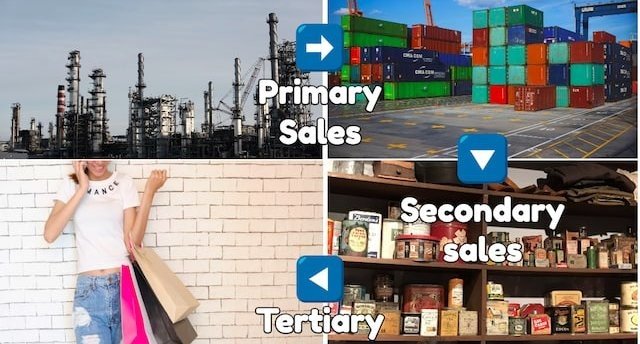
Sales are of three kinds – primary, secondary and tertiary sales .
Primary sales is defined as the transaction between brand and distributor where the latter buys from the former and is billed for it. This kind of sales directly contributes to a brand/manufacturer’s revenue.
Secondary sales is defined as the transaction between distributor and retailer where the sale is highly dependent on the renown of the brand and the distributor’s available stock.
Tertiary sales is defined as the transaction between retailer and consumer, also called offtake. This is dependent on factors like merchandising, visibility, and retailer push.
Primary Sales
Primary sales is the sales or transaction that happens between the manufacturer/brand and a distributor.
An invoice is generated as per the manufacturer’s pricing and the resultant revenue becomes the net revenue for the brand in question. There are a number of factors that influence primary sales such as brand value, popularity, distribution network, secondary sales performance of the relevant distributors, and even the overall consumer reaction towards a product.
You may be wondering how offtake, which depends on consumers and retailers, could possibly have a significant impact on brand-distributor transactions. Everything a brand sells to a distributor goes down the line and ultimately to a consumer and if demand stunts at the consumer level, then demand will start diminishing up the supply chain as well.
An example of primary sales is when Colgate ships its dental products all over a region or a country, they do so via distributors with whom retailers have placed orders for Colgate products. As Colgate sells its products to the distributors at a predetermined price, the revenue generated is what Colgate gets out of their overall investment on making the product.
Secondary Sales
When a distributor sells your products to a retailer or restocks a retailer as per the order a retailer places with you, it’s called secondary sales.
Although brand awareness is important for secondary sales, the following are crucial as well:
- Stock availability must be ensured to meet retailer demands
- The distributor needs to have an efficient and reliable system of transportation and order tracking
- Trade promotions incentivise retailers to order more, which means better schemes and promotions lead to better secondary sales
A brand must keep an eye on secondary sales to identify any distributors who are not doing well as in monitoring their stock or order fulfilment. If a distributor is below the accepted threshold, you must reevaluate your network and find new distributors who can meet expectations.
An example to consider would be a market giant like Britannia and a lesser known Company A. Consumers are more likely to buy Britannia products as opposed to a brand they don’t know about and retailers know it. Consequently, retailers will naturally go for Britannia products that will presumably sell better at their stores. In such cases, Company A would have to have an effective marketing strategy in place to be able to compete with such odds.
Tertiary Sales
Tertiary sales is the final stage of a sales process and involves consumers buying products from retailers at stores. This is the ultimate goal of all manufacturers and product owners as consumerism is what decides the viability of a product in the market. Exclusive to B2C sales, tertiary sales is unpredictable and necessitates a lot of strategising in the form of merchandising, advertising, special offers and discounts, and marketing campaigns to remain relevant and in the public eye.
Good tertiary sales performance requires the product to be convenient and genuinely useful to consumers. They should look at it as more than an optional luxury and instead something that can add to their lifestyle. A bar of chocolate or a box of chopped vegetables are both relevant in this matter – one for taste and euphoria and the other for ease of use in our fast lives.
Brands need to have a strategy in place to stay in the limelight and once they have a good market share, they can move their product down the supply chain faster and in turn, enhance tertiary sales at stores. This means the more popular you are, the better the chance for successful offtakes. Price is also a factor as the presence of more economical options can potentially divert consumers elsewhere.
| Primary Sales | Secondary Sales | Tertiary Sales |
| Happens between brand and distributor | Happens between distributor and retailer | Happens between retailer and consumer |
| Directly affects brand revenue | Directly affects distributor revenue | Directly affects retailer revenue |
| Sold at manufacturer’s price | Sold at trade price | Sold at maximum retail price |
| Ensures availability of products in the market | Focuses on satisfying consumer demand | Focuses on giving product access to consumers |
FAQ
Why Optimise Sales?
Primary Sales Optimisation
- Optimisation of primary sales equips a brand to establish a dependable distribution network and enhance market reach
- Optimisations such as production planning, inventory management, order processing, and delivery efficiency results in a streamlined supply chain
- Outperform competitors through product availability, efficient distribution, and competitive pricing
Secondary Sales Optimisation
- An optimised secondary sales process means retailers are always adequately stocked via a steady supply of products. Less inventory outage means retailers are better prepared to meet consumer demand.
- A well-optimised secondary sales process means that retailers have fewer complaints, are well informed, and trust the brand. Additionally, incorporation of loyalty points and special schemes in secondary sales provides the much needed push for retailers to buy more from brands.
- Optimised secondary sales focuses on ease of transaction, order placement, and order tracking for retailers, building both trust and loyalty. This, in turn, leads to more cooperation, enhanced brand support, and better sales.
- Secondary sales optimisation gives brands access to sales data that they can use to monitor and evaluate retailer performance. Inventory levels and KPIs can potentially identify high-performing retailers and reveal areas of improvement, leading to effective allocation and targeted assistance.
- It is essential to have an optimised secondary sales process to enhance your brand image. Optimisation allows for clear brand guidelines, product information, and marketing materials for retailers to accurately and appropriately push your product to consumers.
Tertiary Sales Optimisation
- Tertiary sales optimisation ensures that products are effectively marketed, promoted, and available to consumers, thereby enhancing the chances of sales and generating more revenue
- Targeted marketing strategies, advertising campaigns, and product positioning can captivate consumers and expand your brand’s presence. This increases your market share.
- Optimised consumer-facing sales leads to positive consumer experiences, thus boosting brand loyalty. Happy consumers are more likely to recommend your products to others via word-of-mouth.
- By delivering high-quality products, providing excellent customer service, and addressing consumer needs and concerns, you enhance the overall customer experience. Satisfied customers are more likely to become repeat customers, fostering long-term relationships and customer loyalty.
- Optimisation of tertiary sales also helps you differentiate your brand and products from the competition and potentially positions you as a preference among consumers
Practice area's of B K Goyal & Co LLP
Income Tax Return Filing | Income Tax Appeal | Income Tax Notice | GST Registration | GST Return Filing | FSSAI Registration | Company Registration | Company Audit | Company Annual Compliance | Income Tax Audit | Nidhi Company Registration| LLP Registration | Accounting in India | NGO Registration | NGO Audit | ESG | BRSR | Private Security Agency | Udyam Registration | Trademark Registration | Copyright Registration | Patent Registration | Import Export Code | Forensic Accounting and Fraud Detection | Section 8 Company | Foreign Company | 80G and 12A Certificate | FCRA Registration |DGGI Cases | Scrutiny Cases | Income Escapement Cases | Search & Seizure | CIT Appeal | ITAT Appeal | Auditors | Internal Audit | Financial Audit | Process Audit | IEC Code | CA Certification | Income Tax Demand Notice | Psara License | FCRA Online
Company Registration Services in major cities of India
Company Registration in Jaipur | Company Registration in Delhi | Company Registration in Pune | Company Registration in Hyderabad | Company Registration in Bangalore | Company Registration in Chennai | Company Registration in Kolkata | Company Registration in Mumbai | Company Registration in India | Company Registration in Gurgaon | Company Registration in Noida | Company Registration in lucknow
Most read resources
tnreginet |rajssp | jharsewa | picme | pmkisan | webland | bonafide certificate | rent agreement format | tax audit applicability | 7/12 online maharasthra | kerala psc registration | antyodaya saral portal | appointment letter format | GST Search Taxpayer | caro 2020 | Challan 280 | itr intimation password | internal audit applicability | preliminiary expenses | mAadhar | e shram card | aaple sarkar portal | epf activation | scrap business | brsr | depreciation on computer | west bengal land registration | traces portal | Directorate general of GST Intelligence | form 16 | rtps | patta chitta

